
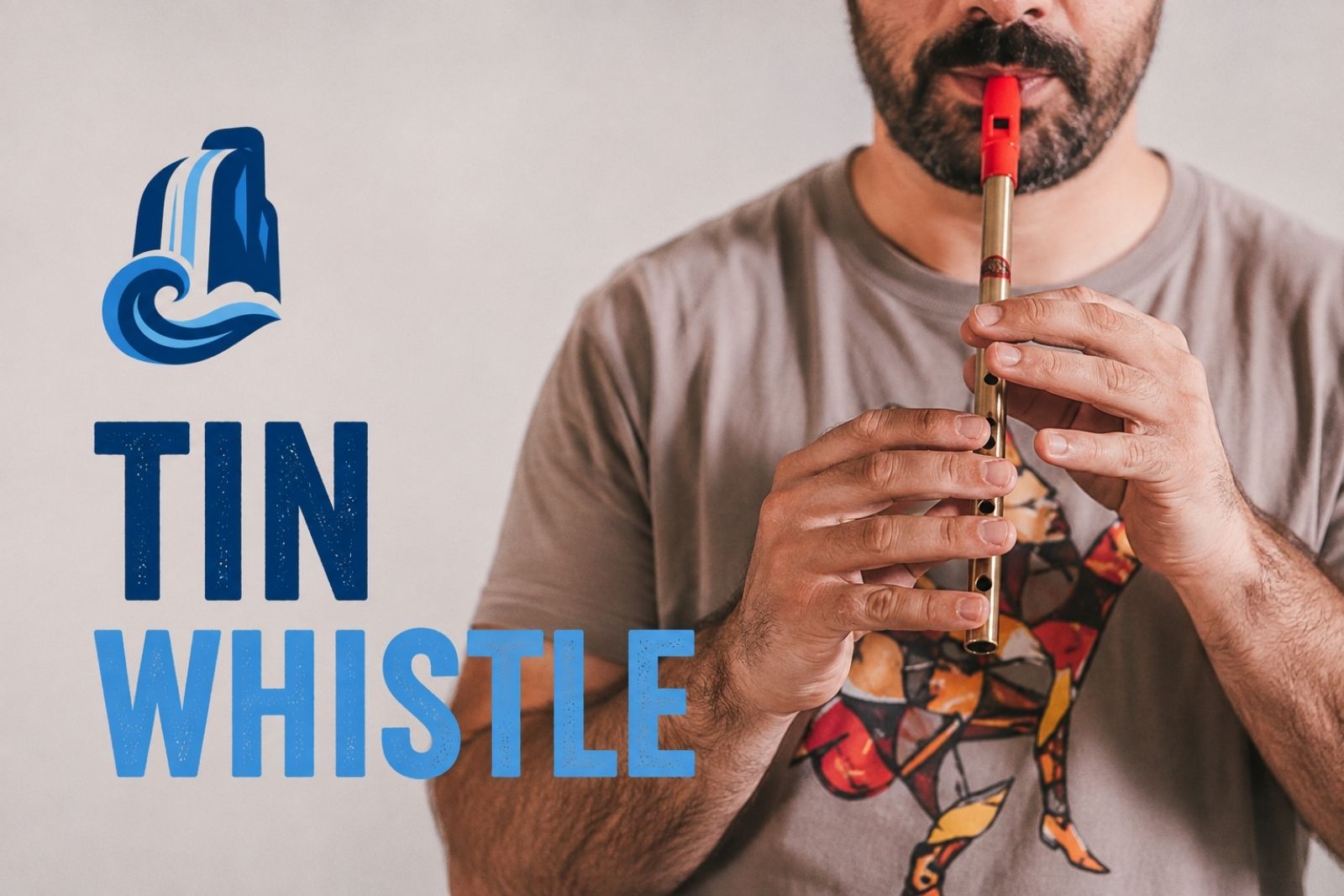
These aren’t the typical questions you’d type into a search engine about “what is a tin whistle.” They’re the ones that actually come up in the first Individual Lessons at EMTI Fervienza, when someone picks up the instrument for the first time and starts to play.
“Am I holding it right?”
This is almost always the first question, even before the first breath. The tin whistle is held with both hands, fingers covering the holes without excessive tension in the wrist or shoulders. The most common correction in the first lessons isn’t about finger placement — it’s overall posture: shoulders creeping up, neck pushing forward. Posture gets tuned before the note does.
“Where do I start blowing from?”
The second almost automatic question. The tin whistle responds to air pressure, not just to whether you blow or not: too hard and the sound breaks toward the sharp; too soft and it barely sounds at all. In the first sessions, most of the real work happens here, not in fingering — finding that steady pressure is what makes the first notes come out clean.
“Why does this note come out fine and the one next to it doesn’t?”
You start from wherever you are: nobody arrives already mastering all eight basic notes at once. It’s normal for one particular note to be harder than the ones around it — usually because of a finger not fully covering the hole, or a pressure change when moving the hand. It isn’t a sign that something’s wrong; it’s the ordinary texture of learning new fingering.
“I come from [another instrument]: what’s going to feel strange?”
This is one of the most frequent questions among students who already play something — piano, guitar, transverse flute. What tends to surprise people most:
- Coming from keyboard or strings, you notice that here pitch doesn’t depend only on “pressing the right key”: air pressure also sharpens or flattens the note, something that doesn’t exist on a piano.
- Coming from transverse flute, you find the tin whistle’s fingering more direct (fewer keys, a simpler system), but you have to relearn the relationship between air pressure and pitch, which works differently on every wind instrument.
- Never having played any instrument before, you don’t have that point of comparison — and in practice you’re not at a disadvantage: having no prior habits to unlearn actually simplifies some things.
“Do I need to buy a specific tin whistle to start?”
At EMTI Fervienza we work with our own beginner instrument, designed for the first lessons. You don’t need to arrive with a specific model already decided — it gets sorted out as part of starting, not as a requirement to meet before the first session.
“How long will it take me to play something recognisable?”
It depends on each person, and we don’t promise a fixed timeframe — that’s exactly the kind of claim we avoid making without real data behind it. What is consistent, session after session, is that the first recognisable pieces tend to arrive sooner than students expect at the start, precisely because the tin whistle has a more direct learning curve than other wind instruments.
If any of these questions sound familiar
These are the questions Tever Díaz García, founder of EMTI Fervienza and Técnico de las Enseñanzas Profesionales de Música, gaita specialty, from the Conservatorio Profesional de Oviedo, answers in Individual tin whistle Lessons. If you recognise yourself in any of these doubts, you’re probably closer to starting than you think. Individual tin whistle lessons in English are on their way — meanwhile, you can see the rest of our course offering or get in touch to talk through your specific case.