
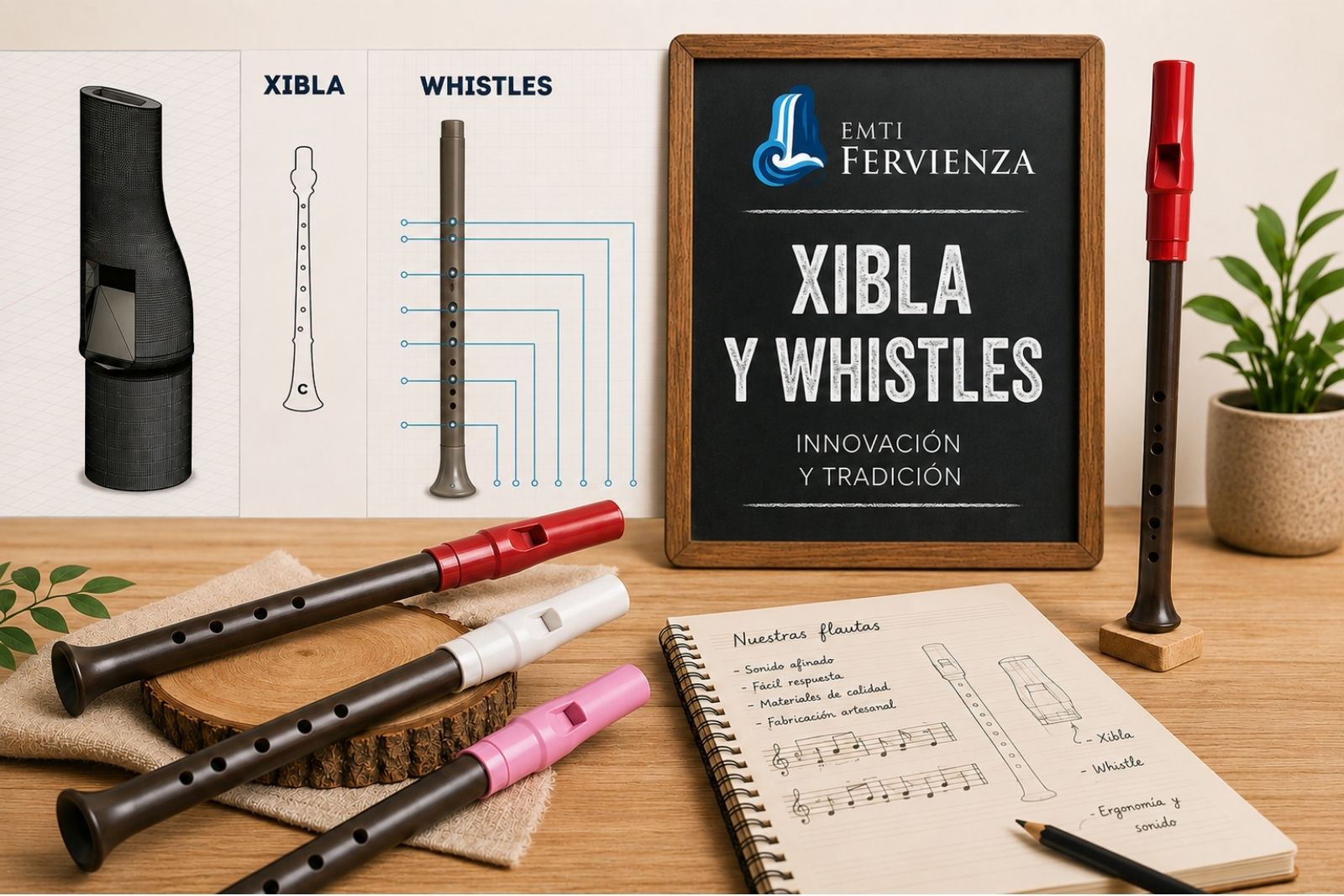
At EMTI Fervienza, innovation doesn’t mean technology for its own sake: it means technology put to the service of tradition. The Xibla is a direct example of that principle applied to teaching Asturian bagpipe. This article isn’t about how it’s made — that story, told by its creator, lives elsewhere. Here the question is different: what does the Xibla solve inside a lesson.
The problem it solves
Starting Asturian bagpipe from scratch means coordinating several things at once: breathing, the steady pressure of the bellows — the bag that feeds the instrument with a continuous flow of air — and fingering. When all of that is worked on at once, on the full instrument, it’s easy for students to spend more energy just holding everything together than understanding each part on its own.
The Xibla isolates the fingering and pitch work of the punteru — the chanter, the tube where the fingers sit to play the notes — without the added demand of the bellows and continuous breathing. It doesn’t replace the Asturian bagpipe, and it isn’t meant to be a different instrument: it’s a stepping stone, designed so the first phase of learning can rest on a simpler base before the full complexity of the instrument is added.
How it fits into the progression of levels
In a One-on-One Class, the Xibla isn’t a product gimmick: it’s a tool the teacher uses surgically at the beginner level, while overall coordination is still being built. As fingering settles, the class brings in the rest of the Asturian bagpipe’s technical demands on top of that groundwork. It’s a pedagogical call made inside the One-on-One Class itself, session by session, not a separate test: it’s the teacher, watching your actual progress, who decides when to add bellows and breathing to what you already command on the Xibla.
This means the Xibla isn’t a product sitting apart from EMTI Fervienza’s teaching method: it’s part of it. Its existence answers a specific pedagogical decision, not the idea of selling an extra accessory.
Why the school designs it itself
The Xibla being born inside EMTI Fervienza, rather than as a generic instrument off the market, has a direct reason: it’s designed for what a real class needs, not for a catalogue. It’s the same logic we apply to the rest of our offering — technology (in this case, the actual design and making of the instrument) solves a specific pedagogical problem; it isn’t added just because.
Anyone who already has a Xibla, or receives one when starting their beginner level, also gets access to a closed course on our own platform, built specifically as an entry point into the school’s method — a complement to the One-on-One Class, not a substitute for it.
For anyone who wants the making-of story
The Xibla also has a design and instrument-making story, told in the first person by its creator. This article deliberately stays in the classroom: what it solves for the learner, not how it was built.
One-on-one bagpipe classes in English are on their way — for now, you can get in touch and we’ll let you know as soon as they open. If you’d like to know how the Xibla fits into a real One-on-One Class, you can check our course offering or get in touch directly.