
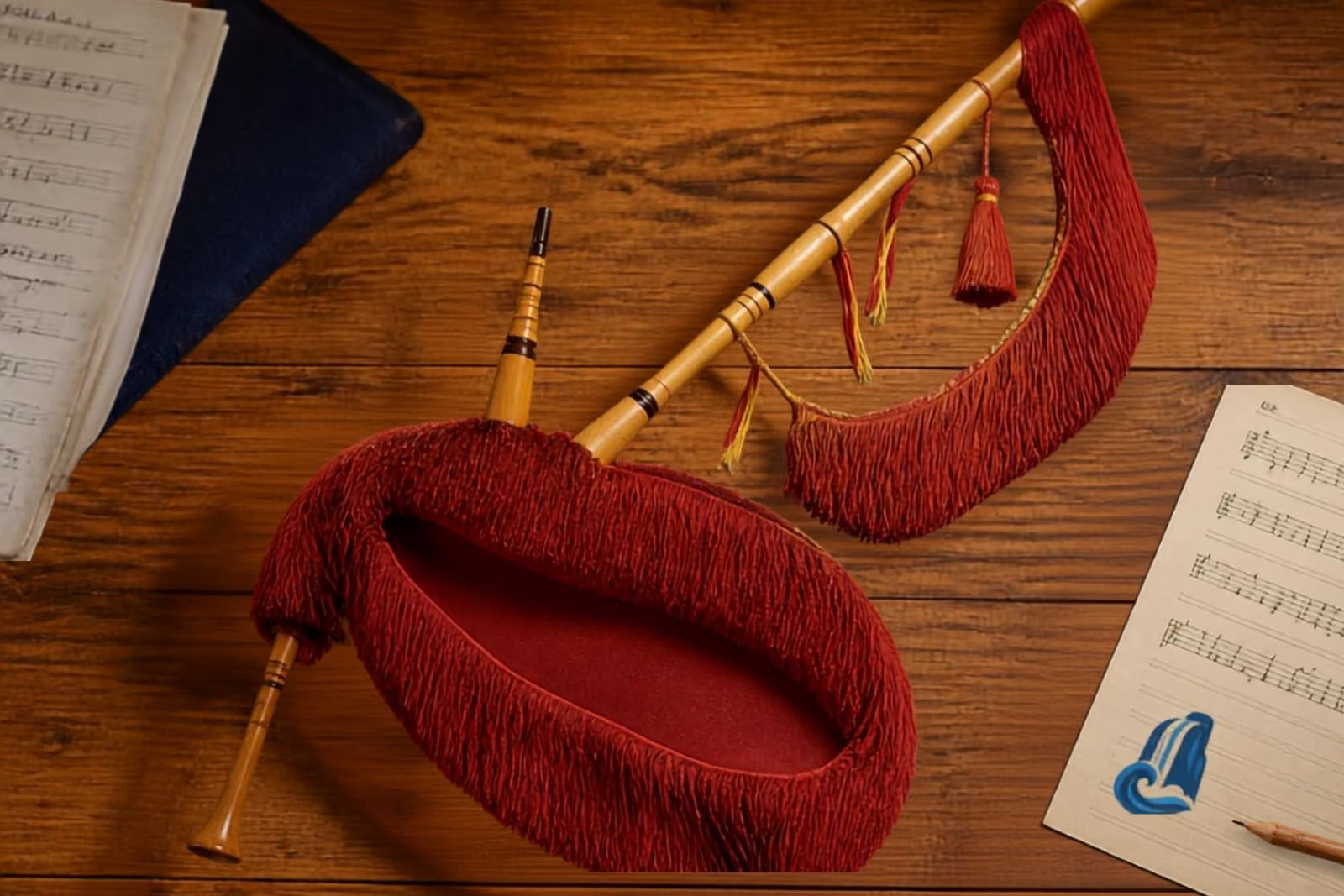
“Bagpipe” isn’t one instrument: it’s a family of instruments, each with its own tuning, its own repertoire, and its own way of being played. At EMTI Fervienza we don’t teach “bagpipe” as a generic concept. We teach Asturian bagpipe. The difference isn’t a catalogue nuance — it changes what gets learned, how it’s corrected in class, and which specific tradition each student connects to.
One word, many bagpipes
Under the same word “bagpipe” live distinct traditions: Asturian bagpipe, Galician bagpipe, Scottish bagpipe (the Great Highland Bagpipe), Bulgarian gaida, and other regional variants across Europe. They share a family — wind instruments with an air bag and reeds — but they don’t share tuning, scale, or repertoire. Learning to play one isn’t learning to play all of them: each regional tradition has its own technique, as distinct from the others as a violin is from a viola.
This isn’t an organology technicality — it’s the first thing that changes how a class is taught. A class on “bagpipe” without further specification has no single valid answer — it depends on which bagpipe is actually being played. A class on Asturian bagpipe does have one: it starts from a defined instrument, tuning, and repertoire from day one.
What this means in practice in the classroom
At EMTI Fervienza, regional specificity isn’t a marketing label — it’s the real starting point of every class:
- The technique taught is that of Asturian bagpipe — fingering, punteo, ornamentation specific to this tradition, not a generic “bagpipe” technique adapted afterwards.
- The reference repertoire is Asturian — the pieces worked on in class belong to that specific tradition, not to a generic Celtic songbook where everything sounds alike.
- Correction in class is measured against that tradition, not against an abstract standard of “how a bagpipe should sound” — what’s correct in Galician bagpipe or Scottish bagpipe may not be correct in Asturian bagpipe, and the other way round (both links lead to articles on tever.es, Tever Díaz García’s personal site — a sister domain, not EMTI Fervienza).
Naming the tradition precisely isn’t an identity gesture added at the end: it’s what gives the class a clear goal from the very first session.
Why this matters to someone who arrives not knowing it
Someone who searches for “learn bagpipe” without further detail often doesn’t yet know that split exists. It’s a legitimate gap, not something to assume away: plenty of people arrive at EMTI Fervienza knowing they want to play bagpipe, without anyone ever having explained to them that “bagpipe” isn’t a single thing.
That said, to be clear without detours: at EMTI Fervienza we teach Asturian bagpipe and tin whistle, not other bagpipe traditions. If what you’re looking for is Galician, Scottish, or any other regional variant, this isn’t your school — and we’d rather tell you here than have you discover it midway through your first class.
Clarifying this early avoids a real problem down the line: learning technique or repertoire from a different tradition than the one you actually wanted, and finding out too late. At EMTI Fervienza, the first conversation with anyone interested in bagpipe also serves this purpose — confirming that Asturian bagpipe is, indeed, what they’re looking for, before building technique on that foundation.
Not the only school teaching Asturian bagpipe online
This deserves the same clarity as everything else: EMTI Fervienza isn’t the first school to offer Asturian bagpipe online, nor the only one today. Other options already teach this tradition remotely. What supports EMTI Fervienza’s offering isn’t having invented the idea of teaching Asturian bagpipe online, but the specific combination it teaches with: Asturian bagpipe and tin whistle, in live One-on-One Classes, accessible from any location and time zone.
The background behind this specificity
Teaching Asturian bagpipe at EMTI Fervienza, rather than “bagpipe” in general, isn’t an abstract catalogue decision: it comes from a concrete teaching background.
- Qualification: Técnico de las Enseñanzas Profesionales de Música (Professional Music Studies Technician), Bagpipe specialty
- Institution: Conservatorio Profesional de Oviedo
- Teaching: Municipal Music Schools of Proaza and Teverga, students of all ages
- Years: 2017–2022, before founding EMTI Fervienza
That background doesn’t turn regional specificity into an empty argument of authority — it makes it concrete. The Asturian bagpipe taught at EMTI Fervienza isn’t a generic version learned from a manual: it’s the one passed on in the very territory where this tradition lives.
If you’re not sure which tradition you want to learn
If you’re interested in bagpipe but aren’t sure yet whether you mean the Asturian tradition or another regional one, that’s a legitimate question and deserves a clear answer before you start, not after. English one-on-one classes are on their way — for now, you can get in touch and we’ll let you know as soon as they open. You can check EMTI Fervienza’s course offering or get in touch to sort out your specific case before enrolling.